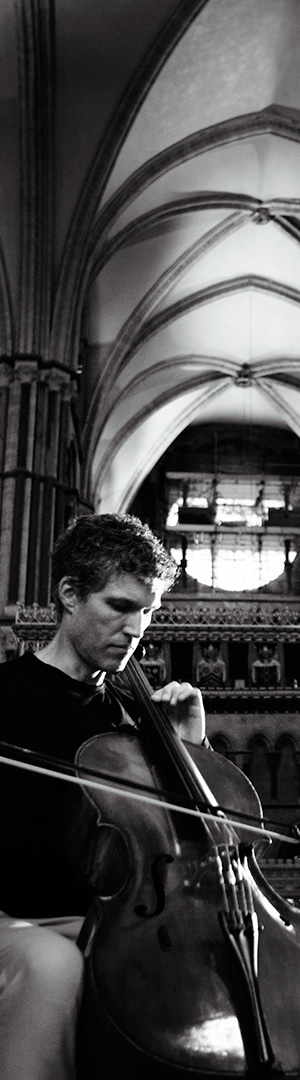

‘[Living programme notes are] a great way to help more casual listeners appreciate the hidden depths of the music.’ – BachtrackIn the second half, the talking had come to an end, but the education continued as our audience were able to hear those techniques in action in a full performance of The Protecting Veil. Matthew Barley’s solo cello represented the Mother of God, which ‘never stops singing throughout’ (Sir John Tavener), with our magnificent strings responding in ‘sensitive ways in which they complemented the solo instrument’ (Bachtrack).
‘City of London Sinfonia seemed alive to the composer’s sense of the spiritual significance of each of the work’s sections.’ – BachtrackThe music moved seamlessly between movements, and between moments of emotional power and meditative calm – a calm that prolonged in a consensus of zen throughout the Hall, before Barley’s dropping of the bow cued a rapturous applause. The standing ovation that followed prompted an encore from Matthew Barley, who demonstrated even more charisma and astonishing technique in Giovanni Sollima’s Lamentatio. City of London Sinfonia blog: Retrospect, The Protecting Veil 6th December 2017 Tavener/Panufnik 99 Words Voces Chamber Choir, Suzi Digby, Matthew Barley, Simon Russell-Beale, James Sherlock. Signum Classics SIGCD519 There are two factors, however, that set this disc apart. The first is the superlative cellist Matthew Barley, who not only serves as soloist throughout but also contributes a new improvisation on Tavener themes. Rhetorical without sentimentality, musical without being self-conscious, his contributions give much of this repertoire (notably Tavener’s Threnos and his Svyati, in which the Protecting Veil becomes a musical shroud) a life beyond Isserlis, and his thoughtful, highly textured improvisation dissolves and reassembles the composer’s signature sounds in a provocative musical intervention and commentary. Alexandra Coghlan Gramophone Magazine Jan 2018 Cellist Matthew Barley’s contributions are beautifully played, not least Tavener’s moving Threnos. ***** Philip Reed Solo cello recital, Kasseler MusikTage 27.10.17 Barley negotiated the difficulty of the piece with notable skill and artistry. The evening approached its end with a “Lamentatio” by Sollima. The lament was layered with finesse, alternating between the sounds of meditation, classical and rock – Barley was in his element and received well-deserved applause. Johannes Mundry, Hessische Allgemeine Trio concert with Avi Avital, mandolin and Manu Delago, hang. Festkeller, Kasseler Musiktage 29.10.17 Kassel Three internationally renowned musicians meet to play a repertoire on which they have been working exclusively in the days leading up to the concert: no one in the audience knows what might happen. This was the concept behind Kassel Music Festival’s surprise concert, which took place in the filled Weinkirche on Sunday evening. Held in the Festkeller, the stars of the show included Israeli mandolin player Avi Avital, British cellist Matthew Barley, and Austrian hang drum player Manu Delago. The hang drum is an instrument that was invented in Sweden in the year 2000, and looks a bit like two big wok-bowls stuck together. If one plays it as well as the Tirolean musician (who has previously worked with pop icon, Björk) then one arrives at pure enchantment. The instrument’s sometimes rounded, sometimes more percussive sounds are fascinating as well as soothing – just the thing for our stressful times. Each a master of his craft, the three musicians combined rhythmic power with tender melodies as they mixed baroque sounds with newer music. The pieces flowed into one another (except for being sporadically broken up with charming introductions from Barley or Avital) and the journey through different time periods was as stylistically open as it was effective. To name three examples: after Avital and Barley had revelled in the burlesque appeal of Jörg Weidmann’s “Bavarian Waltz” (1973), they then went back to 1610. Barley let a melody from Claudio Monteverdi’s “Marienvesper” ring out over softly quivering undertones from Delago. This was followed by one of the hang-drum player’s many compositions, which demonstrated a wild effect: tremolo combined with the simultaneous retuning of mandolin strings. Amongst others, we also heard a contemporary Hungarian piece by Béla Bartók and Zoltán Kodaly; Terry Riley’s “In C”, a minimal classical music piece; and a striking Bach arrangement from which the trio played the last movement of the “Organ Sonata No. 3 in D Minor BWV 527”. After copious applause from the 250 guests, the evening drew to a close with Antonio Vivaldi. Magic in the Festkeller by George Pepl Hessischer Allgemeine Saint-Saëns concerto no. 1 with Frankfurt Radio Symphony Orchestra, conducted by Fabien Gabel 2/11/17 at Sendesaal, Frankfurt ‘The highly virtuosic part presented him with no visible difficulty. Rapid runs and leaps into the highest register using thumb position were brilliantly executed. An outstanding performance.’ Hessische Allgemeine World Premiere ‘At Swim-Two-Birds’ by Pascal Dusapin: concerto for violin, cello and orchestra with Viktoria Mullov, violin, and the Nederlands Radio Philharmonic Orkestr conducted by Markus Stenz. First performed at the Concertgebouw Hall, 30/9/17 Mullova and Barley did not duel with the orchestra, but played tastefully, slowly and with huge leaps in the melody. Their rapid interaction in the cadenza was fascinating.’ NRC Handelsblad Oct 17 ‘Both soloists – violinist Viktoria Mullova and cellist Matthew Barley – get a remarkable amount of space. Their voices are very clear throughout, often against a softly whispering orchestra. Full of beautiful moments, […] Dusapin has added a new masterpiece to the repertoire.’ Nieuwe Noten Oct 17 ‘Dusapin’s love of lyrical melodies is evident throughout the concerto. Mullova grabs you by the throat with violent violin tunes, and Barley gently softens the sounds with his cello. The depth of their playing was magical. At-Swim-Two-Birds will surely become one of Dusapin’s more popular successes’ Concertzender Oct 17 Adam Chamber Music Festival, New Zealand, Nelson Cathedral, February 9, 2017 In just over an hour, my concept of the cello’s reach and repertoire was blown apart, the supposedly-sedate instrument’s horizons, and mine, transformed at the hands of Matthew Barley. In fact the cellist’s whole being works with what seems at times a slight, defenceless creature at his mercy, the things he asks of it, subjects it to, while holding a spellbound audience in thrall. Before beginning a Bach solo, “the pinnacle for a cellist”, Barley explained the harmonic series of the “extraordinary simplicity” of Bach’s Cello Suite No.1 in G Major that includes just 27 notes in 21 minutes. To demonstrate the 1st and 5th notes being “pillars of all music”, Barley had us sing and hold the note D, while he played some of the familiar bars. Then he settled in to play the prelude and five dance movements of the beloved suite where every nuance of every note assumed an added lustre, his audience utterly immersed with him. The cellist’s broad cultural musicianship showed to perfection in the three works that followed, depicting styles of lament tied together by Barley’s superb improvisation. First was Tavener’s Threnos, based on a traditional Greek memorial. Barley’s delivery of the quiet slow chords, solemn pace and pauses, imbued the piece with an other-worldly eloquence in that sacred setting. Then came the unbelievably beautiful harmonies and phrasing of Mark O’Connor’s Appalachia Waltz, within which you could hear the cry and call of the mountains. Barley’s cello then became a pulsating heart-beat that led into the up-tempo gypsy double-beat of Sollima’s Lamentatio, the cello shrieking, keening and drumming before fading out on a blues’ note – classical chamber music turned on its head! What you don’t know you don’t miss – I’m so grateful I didn’t miss this astonishing performance. Reviewed by Judith Paviell for Stuff.co.nz World Premiere of Universal Notes at Darbar Festival, September 16, 2016, Royal Festival Hall, London “Ever since Yehudi Menuhin and Ravi Shankar made their ground-breaking record East Meets West during London’s first flush of enthusiasm for the sounds of Rajasthan, musicians on both sides of the classical divide have been trying to bridge it with other fusions, most now deservedly forgotten. Amjad Ali Khan, master of the North Indian sarod, is critical of that original fusion. ‘The huge limitation was that Menuhin didn’t improvise,’ he once told me. ‘By excluding that, you cut out seventy-five per cent of your possibilities.’ The fusions which followed were in his view mostly too noisy: ‘For me, melody is the most important thing. I have always imagined cello and violin with sarod, complementing one another. Two plucked instruments create confusion, but a combination of bowing and plucking is beautiful.’ And with the British cellist Matthew Barley he went on to prove that at the Royal Festival Hall. Six years on, Barley was back there leading a very different kind of fusion to launch this year’s Darbar Festival, with some top instrumentalists from the Karnatic (South Indian) tradition. Karnatic music is less well-known than Ravi Shankar’s Hindustani kind because it’s had neither a comparable figurehead, nor any big commercial push, but although its textures and forms are different it follows similar principles to those of the music of the North. This fusion, which has been a year in gestation, saw five musicians from the Philharmonia Orchestra sharing the stage with bansuri flautist Rakesh Chaurasia, sitar-player Niladri Kumar, Jayanthi Kumaresh on the sarasvati vina, and Dr S Kartick on the ghatam, an open-topped clay pot capable of a huge range of sounds.
 Photographer Credit: Arnhel de Serra
Universal Sounds was the title of the substantial five-movement piece – shaped by composer Fraser Trainer – which resulted, and I’ve seldom heard a fusion work so convincingly. Each movement grew organically, some led by Western instruments, and some by Indian ones, with lovely juxtapositions: the fruity sound of the bansuri flute making the clarinet sound austere, the cello bending its notes to answer those of the vina, the ghatam – drier and higher-pitched than the tabla, and augmented by konnakol, India’s version of scat singing – beating up a storm. The textures, often based on Western-string drones, were beguiling, and the stretches of group virtuosity had exhilarating intensity.
It’s worth remembering that our colloquial adjective ‘pukkah’ is borrowed from the Hindi word pakka, meaning ‘mature’, ‘cooked’, or ‘perfected’ as applied to seasoned exponents of the Indian musical tradition: this was a very pukkah performance. Anyone curious should catch the Sky Arts broadcast coming soon.”
Posted on
“In India, as in the West, it can be fashionable to lament the supposed decline of classical music. However it is hard to believe in the reality of this trend based on the evidence of a fortnight ago, as Darbar Festival took over the Southbank Centre for three full days. Despite being 5,000 miles away from the music’s homeland, hundreds packed out the Royal Festival Hall to hear some of India’s finest performers present the fruits of their lineage to both new and seasoned ears.
Young listeners who shy away from the Western classical world through a perception of stuffy or reserved formalism can expect none of this from Darbar. This is living music improvised for the exact time and place of performance, and can only be fully experienced as such. Many musicians did not choose which r?ga would best suit the evening mood until taking stage after the previous performer, and audiences did not hesitate to loudly applaud feats of conceptual and technical virtuosity.
The program included bold new musical fusions. Cellist Matthew Barley led Friday’s premiere of Universal Notes, a experimental work blending Western classical forms with both of India’s distinct Classical traditions – Hindustani from the North, and Carnatic from the South. The project was the culmination of a year-long collaboration between Darbar’s organisers and the Philharmonia Orchestra, and featured composed string passages intertwined with powerful Indian rhythms and leads. The ensemble included strings, clarinet, violin, sitar, bansuri bamboo flute, Saraswati veena, and ghatam clay pot, and expertly balanced the unpredictability of Indian improvisation with sophisticated harmonic writing. The electrifying result married the best elements from Eastern and Western classical forms more adeptly than we have heard in any previous fusions of this kind.”
George Howlett, JazzFM, October 3rd, 2016
Photographer Credit: Arnhel de Serra
Universal Sounds was the title of the substantial five-movement piece – shaped by composer Fraser Trainer – which resulted, and I’ve seldom heard a fusion work so convincingly. Each movement grew organically, some led by Western instruments, and some by Indian ones, with lovely juxtapositions: the fruity sound of the bansuri flute making the clarinet sound austere, the cello bending its notes to answer those of the vina, the ghatam – drier and higher-pitched than the tabla, and augmented by konnakol, India’s version of scat singing – beating up a storm. The textures, often based on Western-string drones, were beguiling, and the stretches of group virtuosity had exhilarating intensity.
It’s worth remembering that our colloquial adjective ‘pukkah’ is borrowed from the Hindi word pakka, meaning ‘mature’, ‘cooked’, or ‘perfected’ as applied to seasoned exponents of the Indian musical tradition: this was a very pukkah performance. Anyone curious should catch the Sky Arts broadcast coming soon.”
Posted on
“In India, as in the West, it can be fashionable to lament the supposed decline of classical music. However it is hard to believe in the reality of this trend based on the evidence of a fortnight ago, as Darbar Festival took over the Southbank Centre for three full days. Despite being 5,000 miles away from the music’s homeland, hundreds packed out the Royal Festival Hall to hear some of India’s finest performers present the fruits of their lineage to both new and seasoned ears.
Young listeners who shy away from the Western classical world through a perception of stuffy or reserved formalism can expect none of this from Darbar. This is living music improvised for the exact time and place of performance, and can only be fully experienced as such. Many musicians did not choose which r?ga would best suit the evening mood until taking stage after the previous performer, and audiences did not hesitate to loudly applaud feats of conceptual and technical virtuosity.
The program included bold new musical fusions. Cellist Matthew Barley led Friday’s premiere of Universal Notes, a experimental work blending Western classical forms with both of India’s distinct Classical traditions – Hindustani from the North, and Carnatic from the South. The project was the culmination of a year-long collaboration between Darbar’s organisers and the Philharmonia Orchestra, and featured composed string passages intertwined with powerful Indian rhythms and leads. The ensemble included strings, clarinet, violin, sitar, bansuri bamboo flute, Saraswati veena, and ghatam clay pot, and expertly balanced the unpredictability of Indian improvisation with sophisticated harmonic writing. The electrifying result married the best elements from Eastern and Western classical forms more adeptly than we have heard in any previous fusions of this kind.”
George Howlett, JazzFM, October 3rd, 2016
Around Britten Tour
The Independent 1.1.13 In 2010 when I began to dream up Around Britten, there seemed to be so much time. I could afford to ruminate at leisure on the 100 events that would make up my celebration of Britten’s centenary, the heart of which is taking the wonderful, emotional music of Britten to as many places and people in the UK as possible. Suddenly it was September 2012, the tour was a matter of months away, and I had only confirmed a fraction of what I was aiming for, and half the money needed to pull it all off. I went into overdrive, working 16-hour days – I was touring at the time but the many undisturbed hours in hotel rooms were a blessing. Thinking of places to perform off the usual concert circuit – places where I thought live music would be truly memorable, and where I might find a different audience from the classical music-listening public in the concert halls – was one of my favourite aspects. Click here to read the interview in full. BBC Music Magazine blog Matthew is a guest blogger for BBC Music Magazine. Read his latest blog posts about the Around Britten tour here.Around Britten CD
Sinfini Music January 2013 Julian Haylock
***** Released in conjunction with Matthew Barley’s trailblazing 100-date tour of the UK marking Britten’s centenary year, played in an eclectic variety of venues (including a Devonshire wood), this engrossing recital is a defining statement in modern cello playing. Gone are the days when great players (Rostropovich included) tended to think instinctively on a grand scale, like a metaphorical bear-hug. Barley plays with the micro-instincts of a violinist, shading every phrase with the subtlest of nuances, creating an introspective world of startling poetic images. His treasurable multi-tracked adaptations of Britten folksong arrangements and an absorbing 10-minute improvisation recorded in the wee small hours in Coventry Cathedral provide the icing on a stunningly played and engineered musical cake. Gramophone April 2013 As always, Barley’s playing is fearless. The disc is a voyage around the cello as well as around Britten, and one that never becomes relentless. In his Improvisation, there is skilfully woven reference to the profusion of styles in which he plays…The high point, though, is Barley’s arrangement of ‘Since she whom I loved’. Even without the words, Barley has managed to capture – and further amplify – its great sadness and isolation. The Financial Times, 2.2.13 This will surely go down as one of the more offbeat centenary tributes to Britten. Barley, an unclassifiable cellist, builds his anthology around a thoughtful performance of Britten’s Third Suit for cello and the “quietly radiating peace” he finds in it. BBC Music Magazine, May 2013 His performance of the Britten lets the light in on what can seem a rather obscure, labyrinthine work: Barley’s clear, calm approach lays out the score before us…The rest of the disc is like entering the chill-out room: Barley’s well crafted, multi-tracked cello arrangements of Britten’s folk songs and ‘Concord’ from Gloriana will appeal to many. International Record Review, May 2013 “a formidable achievement” Katherine Cooper, Presto Classical, 14th January 2013 “If a disc based on a funeral chant sounds rather elegiac, well – I suppose it is, rather, but it’s suffused with a rapt, meditative quality that makes for wonderful late-night listening and there’s a splendidly boisterous arrangement of ‘Oliver Cromwell’ to round things off! Matthew Barley further proves his reputation as one of the UK’s most innovative and creative performers” Presto Classical Disc of the week Jan 2013Peasant Girl CD
The BBC Music Magazine September 2011 Martin Cotton Performance ***** Recording *****
This could easily slip into the world or jazz review sections. The opening track, For Nedim, was originally written by a pair of oud players from North Africa. Like most of the music here, it was arranged by Mullova’s husband, the cellist Matthew Barley. Its harmonic world and the structure of a slow, intense introduction followed by a frenetic dance put it firmly in the gypsy tradition. The jazz side arrives with the next track – Django, a tribute to the great guitarist, where Julian Joseph’s economical piano plays against Mullova’s relaxed, idiomatic violin. It was a brilliant idea to combine seven Bartok Duos with music by Bratsch, the French gypsy band, and jazz improvisations from Joseph and the two percussionists: the various musical elements are drawn into a creative symbiosis. The programme, which initially looked bitty, adds up to a coherent sequence, with two numbers by Weather Report not that far away from the world of Youssou N’Dour. All the performances have energy and imagination, and even though Kodaly’s Duo, passionately played by Mullova and Barley, might seem at a tangent to the rest, it makes perfect sense as the culmination of a beautifully recorded album
The Huffington Post 12.8.11 Laurence Vittes If anything proves that classical music is moving in entirely new directions in 2011, this concept album from edgy fiddle player Viktoria Mullova, edgy cellist Matthew Barley and edgy friends seize the listener from the first insane attack of Viktoria’s violin screeching down inflicting pain on her e-string. The effect is electrifying and it belongs to 2 unforgettable CDs of loosely gypsy related music played by some of the great virtuosos of our time and a crack recording crew. This is not music to chill out to, although there are frequent moments of serene beauty, but get a copy and make your hair stand on end like Else Lanchester’s bride of Frankenstein. Everything here is at its core erotic and desperate to please and be pleased, whether it’s an homage to jazz legend Django Reinhardt, Barley’s take on Russian music, or Mullova’s take on life. It’s all over the place, united by wholly imagined and wildly different senses of place, time and spirit, with world music jostling for its share of the booty. Very exhilarating; obviously where classical music’s future lies. The Sunday Times 19.06.11 CD She has already shown us that she can handle a Miles Davis tune. The violinist Viktoria Mullova shreds even more categories on this soulful collaboration with her husband, the cellist Matthew Barley, and a chamber group featuring the pianist Julian Joseph. Gypsy melodies sit alongside Weather Report themes, a Youssou N’Dour number and more conventional pieces by Bartok and Kodaly. The MJQ classic Django has never sounded quite so elegaic, and any doubts that the band can swing are laid to rest in teh exuberant opener, For Nedim. Joseph’s playing throughout is a model of discretion, while Paul Clarvis and Sam Walton add subtle percussive colour. The band’s Prom will be essential listening. The Financial Times 29.07.11 Andrew Clark The music of “Yura” begins ever so gently. A series of subtly changing piano chords punctuates a violin line that develops into a folk-tune. The track lasts a mere five minutes and expires with the same stillness as it began. You don’t need to know how or why it was written to be touched by its beauty. The Gramopone October 2011 Duncan Druce The gypsies provide something of a connecting motif but perhaps it’s better just to sit back and enjoy the brilliant, imaginative playing, with it’ interesting dialogue between the performance styles of jazz and classical music. Lively pieces like For Nedim and The Pursuit of the Woman with the Feathered Hat go with a tremendous swing…Barley’s own Yura gives off a powerfully melancholic aura. Julian Joseph’s piano playing is outstanding. The Kodaly is wonderfully conceived, and Mullova and Barley give a fine performance, with some truly beautiful quiet passages, plenty of energy and passion, and an attractively light, playful style in the finale. All in all this is a very stimulating programme, performed with flair and finesse. The Strad September 2011 James Crel Viktoria Mullova has teamed up with cellist husband Matthew Barley and his jazz-leaning ensemble to deliver an assortment of gypsy-influenced music spanning folk, classical and fusion. An accident waiting to happen, perhaps – but it doesn’t, for a number of reasons. The ensemble is cleverly chosen – Sam Walton’s marimba offers a fresh take on the traditional cimbalom, while Paul Clarvis’s earthy drum kit provides depth and atmosphere. He and pianist Julian Joseph improvise in places, notably when interleaved subtly between the Bartok duos. And Barley’s arrangements seamlessly weave disparate strands and ideas together. Finally it works because Mullova’s playing allows her to traverse this section of repertoire. In the main, hers is a firm, robust but unmannered sound that has a home in both Bartok and the music of French ensemble Bratsch, though she doesc show a deft, light touch when the melodies spiral breathlessly. Barley is well matched to this in the duos, and the end of the second movement of the Kodaly is especially arresting. This is a fine album that understands where stylistic boundaries should be respected or ignored. The Evening Standard 15.7.11 Simon Broughton It’s not often you get Youssou N’Dour, Django Reinhardt, Weather Report and Bartok on one disc. But this is an extraordinary project in which violinist Viktoria Mullova is accompanied by the Matthew Barley Ensemble. The French group Bratsch have inspired two of the strongest tracks, Bi Lovengo and Er Nemo Klantz, interlaced with Bartok duos that dance with an earthy swing. Matthew Barley’s improvised music gives the arrangements a spontaneous feel and, amazingly, it all hangs together. Simon Broughton 27.10.10 Evening Standard (St Lukes concert, November 2010) It’s a stellar quintet of musicians…Most spectacular is the DuOud piece For Nedim, which is an inspired arrangement of Arabic lute music full of syncopated rhythms. With an ensemble such as this, genres like classical, jazz and world become meaningless, which is exactly the point.Proms Performance August 18th 2011
www.theartsdesk.com 19.8.11 Igor Toronyi-Lalic
Two great musical off-pisters: violinist Viktoria Mullova and cellist Matthew Barley. It was crossover at its best. No compromise. Total musicianship. The arrangements (mostly by Barley) helped. The particular colours assembled – cello, violin, piano, marimba, jazz drum kit – melded quite beautifully. Inevitably, each musician excelled in the genre that they are most closely associated with. Mullova was at her best careering around her fingerboard virtuosically, Joseph coolly riffing out quietly subversive bass lines, Barley jamming with style, Walton zipping silkily around his marimba and Clarvis fooling about minimally but with perfect timing on his kit. The high point for me, however, was when the stage was left to Barley and Mullova and Kodály’s Duo. It’s such a unified, hurtling little double-helix of a work anyway, but in the married couple’s hands it was hard to imagine that it more tightly sprung or the two lines more closely and passionately intertwined. That’s what I call a day in the country.The Guardian 19.8.11 Guy Dammann
These players are all class acts…Barley’s Yura, composed in memory of Mullova’s father, and inspired by a view of the Siberian Lake Baikal, unfolds like a long, beautiful gaze held over the course of two long and immensely peaceful phrases. The Independent 24.8.11 Michael Church Viktoria Mullova and Matthew Barley are at once the least likely musical combination, and also among the most fertile. She fledged in Moscow as a star violinist before courageously defecting (at the height of the Cold War) to the West, where her immaculate playing earned her the nickname Ice Maiden. Barley is distinguished from other classical cellists through his hang-loose, collaborative approach and his explorations of jazz. Married life has seen them gradually influencing each other’s style: Mullova’s new CD ‘The Peasant Girl’ – on which she is accompanied by the Matthew Barley Ensemble – formed the basis for the second of these Proms, and shows where their collaboration has now got to. Barley’s arrangements of numbers by Bratsch, John Lewis, and Weather Report’s Joe Zawinul were felicitous, and his elegy to Mullova’s father formed a graceful point of stillness at the centre of the event. The longest work, Kodaly’s ‘Duo, Opus 7’, was rendered with great finesse. www.musicalcriticism.com 19.8.11 Stephen Graham …their performance of the Kodaly duo felt gorgeously companionable, and tonally rich too. The band, which consisted of piano, percussion, and drums, in addition to the frontline violin and cello, played with agility in the faster, chewier pieces (such as Bi Lovengo by Bratsch), and with a sweet lyrical calm in the slower ones (such as the passionate and singing Lewis/Bratsch Django). As befits the style, a palpable freedom drove the performances, with pianist Julian Joseph, particularly, cutting loose on some knotty, compelling solos. The concert built and built in atmosphere, until finally the band really let fly with their last couple of numbers, including the slip-sliding, Taraf de Haidouks-like fun of the seven-beat For Nedim (originally by DuOud). By this point the crowd were variously tapping their feet, clapping along cheerfully, nodding happily, or simply sitting looking content. The Peasant Girl in London “Barley teased soulful eloquence from his cello”The Times Geoff Brown October 28 2010
Tour of Sweden with The Peasant Girl
“Matthew Barley displayed a great technical brilliance as well as a sensitivity on his cello. His bowing and action-packed improvisations and not least his swinging pizzicatos in the last piece were one of tonight’s highlights”Al Ginge Sydostrain, Sweden October 2010
Constant Filter CD
This disc was something of a labour of love for Matthew Barley – he recorded it at home on his own equipment after over the years building up a repertoire of pieces by John Metcalfe for electronic cello. It was a steep learning curve: ‘I was engineer, producer, editor, and computer sound-designer – nottomentioncellist,’hewrites in the booklet. The result is compelling, and at times extraordinary – Metcalfe’s lyrical, contemplative lines are drawn with infinite care, and the immediacy and tenderness of Barley’s performance makes this music addictive. The organum-like sounds of Tracing the Outline, in which the computer duplicates Barley’s sound a fourth below in places, draw you in with their lush, slowly building textures. Constant Filter, the title track, lays a singing acoustic cello line over hovering electronics to great effect. The five movements of Kite, for cello and piano ‘with a hint of electronics’, are brief yet lovely, particularly the dream-like opening and closing movements. Lonely Bay – in which each phrase reappears exactly 40 seconds later – is wonderfully contemplative, and Barley uses his fine ear for colour to make every nuance and gesture count. Metcalfe has achieved the unusual feat of creating electronic music that sounds organic and heartfelt, and in Barley he has a hugely persuasive advocate.Catherine Nelson The Strad Magazine, October 2010
“Cellist Matthew Barley is a fan of John Metcalfe’s electronically bolstered cello music and masters it impressively”Ivan Hewitt, Daily Telegraph, July 2010
“Using computerised octave-splitters and delay units, Barley achieves a surprising depth of sound and harmonic richness, particularly on the title-track, where echoing wisps of electronic sound flutter around the cello like butterflies”
Andy Gill, The Independent 4 stars, June 2010
“Barley’s booklet note explains how he decided it was time that he made a recording at home, and gives some idea of the steepness of the learning curve he faced. He seems to have made the ascent with ease: you’d never know it wasn’t the product of some glitzy studio. His playing, of course, is just as accomplished.”Martin Anderson, International Record Review, July 2010
Residency at Kings Place, London
Matthew Barley was in residence at Kings Place for a few days and I thoroughly enjoyed the two evenings I attended . He is an exemplary cellist, his mind seemingly as focussed as his tone, wheterh he is dispatching Beethoven’s last two sonatas (assisted by the superb Kit Armstrong) with the appropriate blend of rigorous Classicism, inwardness and gruffness, or presenting newer pieces by Armstrong and the almost equally young Misha Mullov-Abbado. Barley and tabla player Sanju Sahai were joined by Adrian Freedman on shakuhachi (Japanese flute) and hang drummer Ravid Goldschmidt in a recital of many improvised beauties – the hang, a wondrous instrument, was new to me. Schubert’s C major Quintet with the Navarra Quartet began prosaically and ended tiredly but made good points in between, and Barley’s contribution was impeccable. A part-improvised, part-structured concert with eleven young string players worked well, but the free-association improvisation session with quintet Between The Note was just getting going when they had to stop. Barley shoud be given the run of the place again.Tully Potter, The Strad, December 2009
The Dance of the Three Legged Elephants CD
Latin-blues-chamber-avant-improv-salon-tango? Obviously a jazz disc then. This kind of potpourri approach to generic convention usually fails because few musicians have a real grasp of a sufficiently wide range of musical ideas. But here’s Barley and Joseph, two exceptions who prove the rule. This set of originals, improvisations and takes on pieces by everyone from Jobim to Ravel are informed, inventive and defy all predictions as to what’s coming next. The title track, evolving from a wonky blues riff into a kind of evocation of Steve Reich jamming with McCoy Tyner at the Penguin Cafe, is outstanding.Roger Thomas, BBC Music Magazine, January 2010
I enjoyed it so much that it just had to be my Recording of the Month…it beguiles and overwhelms alternately – sometimes simultaneously… Both performers combine an interest in classical music and jazz improvisation, ‘crossover’ music in the truest sense of the word, a term often misapplied to saccharin middle-of-the-road compositions. There’s nothing bland about the programme here – instead of the lowest common denominator, this recording presents the highest common factor. If Castellain Sunshine is sunlight through clouds, the Dance of the Three Legged Elephants is a lively form of the blues; the effect is almost hypnotic and it forms a very worthwhile centre-piece to the programme. At times it’s almost as urgent as Stravinsky’s Rite of Spring and as much fun as Saint-Saëns’ Carnaval des Animaux. John McLaughlin’s Miles Beyond is a tribute to Miles Davis by a performer who appeared with him in the 1970s. This was for me almost as much a highlight of the CD as the three Joseph compositions. Barley and Joseph round off the CD with another of their improvisations, Improvisation #2. I’m not even going to try to describe this wonderful piece, except to say that it was the perfect end to a very enjoyable recording and that it left me wishing for more. They couldn’t have crammed much more on, at over 72 minutes – so when will their next CD be appearing? In fact, there is an eleventh, bonus track unacknowledged on my review copy; I’ll leave you to discover the surprise for yourselfBrian Wilson MusicWeb International October 2009
Matthew Barley/Julian Joseph Kings Place, London
John Fordham guardian.co.uk, Sunday 27 September 2009
Cello virtuoso Matthew Barley’s willingness to try anything was what drove his run at London’s Kings Place: a week embracing everything from Schubert and Bach to improv, and including two gigs with his regular collaborator, jazz pianist Julian Joseph. The title of Barley’s series, Xtreme Cello, was perhaps a more accurate description of the whole sweep of the week than the particular hum of this elegantly melodic conversation. Here, the cellist’s shimmering bowed sounds and bass-vamp pizzicatos stroked and chased Joseph’s grooving chord patterns, double-time jazz variations and pushing swing. The two began with an improvised exchange of dark piano chords against softly whistling cello squeals – an episode that turned into the ecstatic rising melody and stamping pulse of John McLaughlin’s 1970s Mahavishnu Orchestra classic, Resolution. Barley and Joseph then adapted Ravel’s violin/piano duet Pièce en Forme de Habanera, stretching out from a faithful account of the Spanish-tinged original into a heated interchange of deep, eddying cello chords and urgent, flamenco-like piano figures. Joseph’s own slyly displaced blues, Dance of the Three Legged Elephants (the title track of the pair’s upcoming album), signalled the full-on release of the pianist’s formidable fast-postbop powers against Barley’s steady bowed beat and string-whacking percussion. Used to Be a Cha Cha, another fast piece of densencounterpoint, brought long-lined variations from Barley that recalled country/jazz violinist Jerry Goodman’s old solos with the Mahavishnu Orchestra. The late-show audience was modest, but they made enough noise to fill the hall.
“one of classical music’s leading mould-breakers”
Michael Church The Independent 29th September 2008
Recital with Rohan de Saram for Spitalfields Festival, London
“This was a brilliantly conceived programme, underlining how all music stems from improvisation….there were two pieces by John Metcalfe, Barley bringing panache to Red!Gold!, a quasi-folk, minimalist work with an electronic shadow, and glorious sound to the languid Constant Filter.”BBC Scottish Symphony Orchestra ****
CITY HALLS, GLASGOW
FIFTY years ago today, William Walton’s idiosyncratic cello concerto was given its British premiere, making it an apt choice for yesterday’s Discovering Music concert with the BBC SSO. Presenter and conductor Charles Hazlewood took the podium to lead us through “three different approaches to a concerto in three movements”. Illuminating their discussion with anecdotes from the Walton’s life and work, Hazlewood and the brilliant young cellist Matthew Barley talked through Walton’s creation as it oscillated between major and minor – much like the composer’s own life. But however enlightening the chat, it was the actual playing of the piece at the end which spoke most clearly. Barley excelled in this moody, broody piece, with its ethereal, otherworldly sound world: hypnotic in the first movement, agitated in the turbulent second and virtuosic in the third.Sarah Urwin Jones – The Scotsman – 13th February 2007
ON THE ROAD – NORWICH ARTS CENTRE “Pushing the boundaries of the classical music genre, cellist Matthew Barley uses improvisations and cultural themes to offer a performance of pure music. Barley aims to do away with the all to freely used labels, delve back into history and do what composers and curious artists have done for centuries – create innovative sound. Playing to a focused and revering audience he performed a dynamic recital on the cello, often backed with exciting and quirky electronic sounds from the computer, and established a warm rapport with the audience before each half of the set, giving us an informal introductions to each composition to follow. His music has no geographical, social or stylistic boundaries, incorporating improvisations on hypnotic Syrian folk music, Gregorian Chants and four centuries of classical music. Matthew says: “As a classical musician I have always been bothered by a feeling that I live and work in something of a kind of bubble – and that classical music has some kind of purity that needs protecting. I completely disagree with this idea. Classical music is only a label and this vast body of work covering centuries and countless countries seems to me to be a very open landscape.” Charismatic, dynamic and breathtakingly talented, Matthew Barley is a young man with passion for his music and who is not afraid to experiment against the norm, resulting in completely ground-breaking musicianship.”